

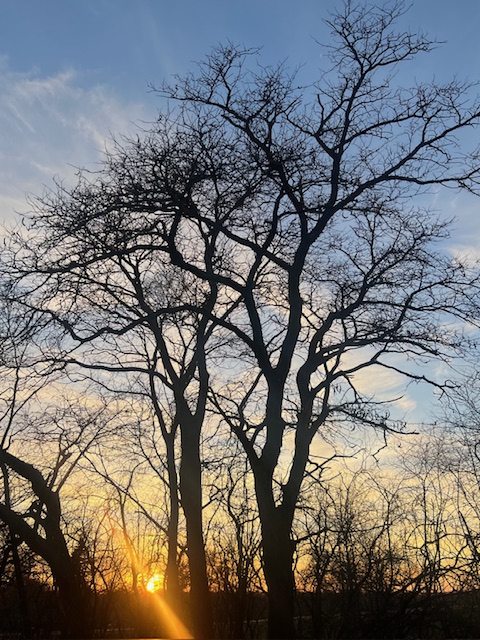
This past weekend, the Chicagoland area felt more like May than February, with bright sunshine and temperatures climbing into the 60s. That is far from typical for this time of year, when winter usually still has a firm grip on us. But as the sun held steady and life seemed to reappear almost out of nowhere, people lingering outside, children riding bikes, dogs pulling their owners down the sidewalk, I realized just how much I have been longing for light. For warmth. For the gentle reminder that spring always comes.
I am always certain winter will arrive. I brace for it. I expect it. But when spring shows its face, I am somehow surprised, as if I did not know it was promised all along. And it makes me wonder, should I carry the same certainty for spring that I do for winter? This tension exposed one of the ways I have come to think about longing.
Longing is one of the most persistent experiences of being human. No matter how full life feels, there is always something just beyond our reach. Just when one desire is met, another rises in its place. We long for companionship, then stability, then purpose, then rest. We tell ourselves that once this next thing arrives, this relationship, this season, this clarity, we will finally feel fulfilled. And yet the ache never fully disappears.
What do we do with that longing?
For many of us, longing feels suspicious. If I were more content, would I want less? If I trusted God more fully, would I ache this much? We quietly wonder if desire itself is evidence of immaturity or ingratitude.
But when we turn to the Book of Genesis 2:18–25, we find something surprising. Longing existed before sin did. Before shame. Before brokenness. In a world God called very good, there was still something not good.
This story invites us to reconsider what our longings mean and what fulfillment looks like. They are not interruptions to the good life. They are not proof that something has gone wrong. They may, in fact, be part of how God designed us.
If life is full of longings, and it is, we are invited to hold them not with shame, not with panic, but with trust in the God who sees what we need before we do. Longing is not something to suppress. It is something to understand. It reveals what we were made for.
These longings are not mistakes or distractions. They reveal something about who we are and how we were made. From this story, we can uncover three truths about longing and fulfillment that point us toward the ultimate joy God has prepared.
God’s Design for Our Longings
18 Then the Lord God said, “It is not good that the man should be alone; I will make him a helper fit for him.”
To understand what our longings reveal, we have to start where Scripture does—before sin ever entered the story. Adam enjoyed perfect communion with God. He had no idols, no doubts, and no experience of brokenness, yet God recognized a longing in him. This shows that longing is not evidence of spiritual immaturity or sinful discontent. It was part of creation, not the fall.
And God did not leave Adam to wrestle with that longing on his own. He saw what Adam lacked before Adam even spoke, and He moved to meet it, planning to satisfy the longing for companionship before Adam even recognized it. “It is not good that the man should be alone,” God declared, and in His response, He acted to provide. In effect, God was saying, “I will fill him with good things.” Psalm 107:9 affirms this truth: “For He satisfies the longing soul, and the hungry soul He fills with good things.”
Far from proving dissatisfaction, Adam’s longing reveals the intentional design of our hearts and God’s care in meeting them. We were created to desire and to be filled, and these desires rest safely in the hands of a God who knows us more fully than we know ourselves. Our longings are not accidents or flaws. They are invitations to trust the One who acts on them before we even realize we are hungry.
Waiting’s Role in Our Longings
19 Now out of the ground the Lord God had formed every beast of the field and every bird of the heavens and brought them to the man to see what he would call them. And whatever the man called every living creature, that was its name. 20 The man gave names to all livestock and to the birds of the heavens and to every beast of the field. But for Adam there was not found a helper fit for him.
God sees our longings before we do, and He promises to satisfy them. But even in Eden, there is a pause. God notices Adam’s need, yet Adam must live in a season before it is fulfilled. Even in a world without sin, longing comes with a waiting.
He brings the animals to Adam. He lets him name them all. And still, none are the helper he needs. After the fall, that waiting becomes sharper and harsher, crowded with sin, disappointment, and moments when we feel unseen. Sometimes He offers what would truly fill us, but we refuse it, looking for satisfaction in what cannot satisfy.
Mark Vroegop writes in Waiting Isn’t a Waste, “Waiting requires living by what I know to be true about God when I don’t know what’s true of my life.” This is humility in action. It is saying, “I think I know what will fill me, but You know better, and You will give it at the right time.”
Imagine Adam reaching for the wrong thing, thinking it might satisfy. He would have walked away frustrated and restless. Waiting is not a season to flee. It is one of the essential ingredients that shape fulfillment.
Cost’s Purpose in Our Fulfillment
21 So the Lord God caused a deep sleep to fall upon the man, and while he slept took one of his ribs and closed up its place with flesh. 22 And the rib that the Lord God had taken from the man he made into a woman and brought her to the man. Then the man said, “This at last is bone of my bones and flesh of my flesh.”
Fulfillment always costs something.
Before Adam received what he longed for, God took a rib.
A bone from his side.
A piece of himself.
Some of us believe joy should arrive untouched by discomfort—easy, effortless. If it hurts, it must not be from God.
Others swing to the opposite extreme. We are ready to give anything for what we think will make us whole. We strive. We sacrifice. We exhaust ourselves trying to secure joy with our own hands.
Adam speaks to both. He had no proof the ache would fade and no guarantee it would be worth it. He went to sleep not knowing what he would wake up to, yet he trusted God with the results of the cost.
God was doing something. By taking Adam’s rib, God was doing more than gathering material. He was inviting Adam into the fulfillment. Eve was not simply placed beside him out of thin air; she was formed from him. She was woven into his very being.
Part of why she was so precious was that she cost him something. When God calls us to a cost, He is not diminishing us. He is shaping something that will make the joy deeper, weightier, more personal. The cost became part of the beauty. Adam’s words capture it perfectly: “This at last is bone of my bones, and flesh of my flesh.” What had felt like loss now stood before him as life, a gift shaped through surrender.
But the story does not only correct those who avoid cost. It also speaks to those who try to carry it all themselves. Adam was asleep. There was a limit to what he could give. The fulfillment did not ultimately depend on his effort. God worked for Adam, not Adam for God. Adam participated, but he did not manufacture the gift.
Idols whisper differently. They say, “Give a little more. Try a little harder. Bleed a little longer, and then you’ll have fulfillment.” But idols never stop asking. They drain. They diminish. They leave us empty and lifeless.
For those who think joy should cost nothing, the rib reminds us that true fulfillment invites surrender. For those who are willing to bleed for anything that promises happiness, the deep sleep reminds us that we are not the architects of our own joy.
Fulfillment always costs something, yet in God’s hands, the cost becomes part of the gift’s beauty.
Hope’s Place in Our Fulfillment
So how should we think about longings in this life? Not every longing will be fulfilled here, and rarely in the way we imagine. Believer, longings are not interruptions or evidence of failure. They are an echo of our design, a whisper of the God who made us to be filled. He knows what your heart truly hungers for even before you are aware of it. He has promised to fill the hungry soul with good things.
Maybe longing is not something to silence or solve, but something to trust. Just as winter feels certain, spring is just as sure. Our ache does not mean absence. It means something is coming. We may live in seasons that feel cold and dormant, but warmth is not a myth. Fulfillment is not wishful thinking. The same God who designed the rhythm of winter and spring has written redemption into the story of our desires.
Spring always comes. And so does He.
God knew we would need a Savior before we even realized it, before we felt the hunger pangs for Someone perfect and worthy. He did not give Him immediately. We waited for generations. We cannot know all the reasons for His perfect timing, but we do know this: waiting stretched hope, waiting shaped trust, and waiting deepened our desire for the Messiah.
And fulfillment came at a cost. Not ours, but God’s. The life of His Son. Blood poured out. Love fully given. So that our longings for life, for wholeness, for communion with the Creator could finally be satisfied.
This is our hope, one day, the waiting for wholeness will end, and fulfillment will stand before us, radiant and complete. Hold on to the day when we will see our Savior face to face and join the chorus of all the saints, singing
Holy, holy, holy is the Lord God Almighty.
He is bone of our bone.
He is flesh of our flesh.

 Hope-Lit Letters
Leave a comment